It’s the giving season, and New Hampshire charities need your help

When a state of emergency was declared last spring, not only did local businesses close and unemployment rates rise, but many charities were left without the ability to raise donations via in-person events. They also couldn’t rely on volunteers to carry out critical parts of their missions.
And, while nearly 500 nonprofit organizations across the state received federal emergency CARES ACT funds to bridge some gaps, this holiday season many remain cautious about their ability to raise enough money as 2021 approaches and the COVID-19 pandemic continues.
“Fundraising is a little more unpredictable than usual as nonprofits pivot from the possibility of in-person events to virtual ones, and as individuals and companies deal with the financial impacts of the pandemic,” said Jen Little, development director of City Year New Hampshire, a nonprofit that matches Manchester schools with Student Success Coaches, young adults who provide classroom support to teachers in both in-person and virtual settings.
“We had to cancel our Starry Starry Night gala this past spring and are working on adapting next spring’s gala to an online event, which leaves some uncertainty as to if we will reach our financial goal.”
Little added that many longterm supporters have shared their uncertainty about their ability to donate as much as they have in previous years.
“We’ve had to rely on some relief funding and other public sources of support more than in the past to help us bridge these gaps,“ she said.
City Year New Hampshire, along with other nonprofit organizations such as the National Alliance on Mental Illness (NAMI NH), Families in Transition-New Horizons and the Animal Rescue League of New Hampshire, all plan to redouble their outreach and fundraising efforts this holiday season, asking Granite Staters to give so that they can continue to give back.
While their missions differ, each charity continues to serve New Hampshire’s most vulnerable populations — including struggling students, those battling mental illness, individuals and families coping with homelessness and food insecurity, and animals facing abuse and neglect.
SUPPORTING STRUGGLING STUDENTS
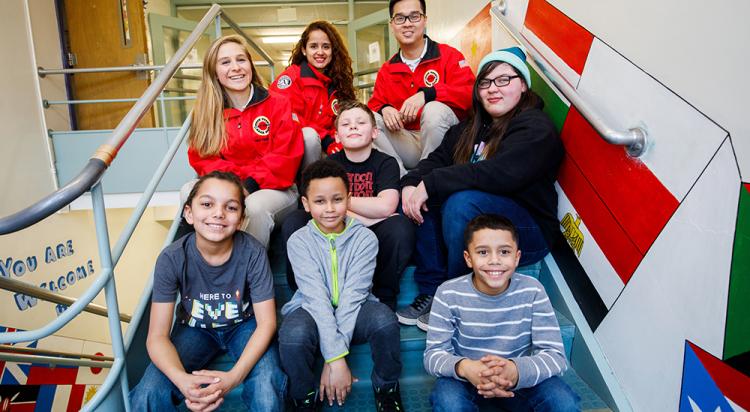
City Year NH’s AmeriCorps members, above and right, support teachers and students in the Manchester School District. They have assisted with the transition to hybrid and remote learning models this year. COURTESY PHOTOS
Teachers, parents, and students throughout the state have grappled with changing learning formats since last spring. The Manchester School District started off the year learning remotely, made the pivot to hybrid learning, and once again is conducting classes online as the pandemic continues.
To help provide much-needed support, City Year NH’s AmeriCorps members function as Student Success Coaches. working alongside teachers and students, and contributing to a positive and welcoming school culture, climate, and community, Little said.
City Year New Hampshire has worked with Manchester schools for a decade to assist educators in Grades 3 to 7 at Bakersville, Gossler Park, Henry Wilson, McDonough, and Northwest Elementary Schools, and at the Middle School at Parkside.
“When schools shut down in the spring, we had to pivot on the spot. The district kept coming back and saying that there was a real problem with student engagement — the same students not showing up, and challenges with technology and accessibility,” Little said. “Our members are doing things like helping troubleshoot technology issues, and helping families learn how to access virtual learning and navigate the platforms.”
Young adults across the United States between the ages of 17 and 25 are invited to apply for Student Success Coach roles in locations across the country, including New Hampshire.

More than two-thirds of this year’s 60 City Year NH ambassadors are from outside of the state; 35% are of color, and 43% speak another language — better reflecting the diverse student population of Manchester, Little said.
Suzanne Provost, a fifth-grade teacher at the Middle School at Parkside, has been happy to have had the support of City Year.
“City Year has added immeasurable value to my classroom throughout the years, but especially during this pandemic by connecting with students in both the physical and virtual environments. Having City Year in the classroom allows for increased student engagement through small group work and one-on-one interactions,” Provost said.
City Year New Hampshire is located in Manchester but was initially founded in Stratham. For the first 10 years, City Year NH served across the state in multiple communities (Exeter, Dover, Somersworth, Seabrook, Hampton, Manchester, Nashua), but since 2010 has moved its location and service focus to Manchester.
The nonprofit is part of the national City Year organization and gets about a third of its funding through Ameri-Corps. The rest is raised through municipal funding or private donations.
AmeriCorps requires that City Year raise a match of 2:1 to receive funding, Little said. The organization is still making up for the loss of its Starry Starry Night event, although it did receive some federal emergency CARES Act relief. Little expects it will be a tough year for nonprofits to forecast fundraising.
“We are a small market and don’t have the volume of big city companies and wealth,” she said. “Every person and every donation is important for us to steward, maintain, and build. We know we are a small community and we do the best we can.”
HOW YOU CAN HELP CITY YEAR
Beginning on Giving Tuesday (Dec. 1) and continuing through December, donors can support City Year by going to https://secure.qgiv.com/for/mfgc/. Donors can also contact Jen Little at jlittle@cityyear.org, or call 218-5125.
People can also offer encouraging words to young Ameri-Corps members, teachers, and students through City Year’s social media outlets: Facebook: @CityYearNewHampshire, and Twitter and Instagram: @CityYearNH.
To keep up with City Year NH, check out their newsletter: https://bit.ly/CYNHInfo.
MEETING THE CHALLENGES POSED BY THE MENTAL HEALTH CRISIS
For NAMI NH, an organization that provides support, education, and advocacy to New Hampshire residents affected by mental illness and suicide, the lack of in-person events has not necessarily diminished the generosity of donors, but the demand for mental health services has skyrocketed, according to Kristen Welch, director of development.
“NAMI NH receives minimal funding for advocacy, a key component of our mission, and relies on fundraising to support these activities,” she said.
As a grassroots coalition of people living with mental illness and their families, NAMI NH for 35 years has served Granite State children, transition-age youth, adults, and seniors, offering statewide activities which provide education/training and support to individuals and communities.
Last year, NAMI NH provided support, education, and advocacy to more than 33,000 individuals. The organization was the recipient of the 2019 Nonprofit Impact Award from the NH Center for Nonprofits.
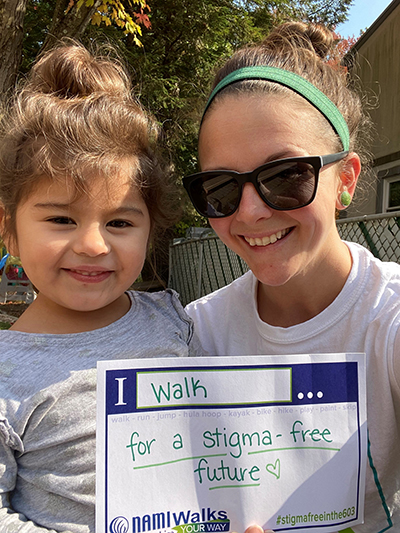
NAMI NH’s in-person events went virtual this year. COURTESY PHOTO
According to Welch, the emergency department boarding crisis is one of NAMI NH’s top advocacy priorities.
“COVID-19 has clearly had a profound impact on the number of New Hampshire youth under the age of 18 who are experiencing a mental health crisis and in need of hospitalization. On Oct. 8, there were 36 youth being boarded in emergency departments around the state — with many of them having been deemed a danger to themselves or others as a result of mental illness,” she said. “This exceeded the previous high mark for youth waiting for inpatient admission of 27 in May of 2017.”
COVID-19 has dramatically slowed the ability of hospitals to discharge individuals needing residential placements — especially youth. Locating appropriate housing for adults has also been challenging, Welch said.
Mental health needs will continue to rise as a result of the pandemic. The economic, social, and physical impacts of this crisis will have an unprecedented impact on the mental and emotional health of New Hampshire’s citizens and our communities, said Susan Stearns, deputy director of NAMI NH.
“Disasters are generally accompanied by increased levels of anxiety, depression, and stress — all of which are amplified by isolation and a disruption to our daily lives,” she said.
“Individuals and families are facing uncertain economic futures, which can cause despair and hopelessness. Familiar routines have been lost, and many Granite Staters are juggling a new — and often stressful — reality of working remotely and virtual learning. Vulnerable populations, particularly children, are especially at risk of increased problems such as depression and substance misuse.”
NAMI NH has been serving the Granite State for 35 years. COURTESY PHOTO
The organization’s year-end appeal is underway; donations will be used for support, education, and advocacy for all in New Hampshire affected by mental illness and suicide.
Welch and Stearns urge loved ones and community members to keep an eye out for one another and practice their own self-care as the pandemic enters its ninth month. If you or someone you know is struggling emotionally, NAMI offers the following support hotlines:
• National Suicide Prevention Lifeline: Call 1-800-273-TALK (8255) for free and confidential support for people in distress, prevention and crisis resources for you or your loved ones, and best practices for professionals.
• Veterans Crisis Line: Veterans and their loved ones can call 1-800-273-8255 and Press 1, chat online, or send a text message to 838255 to receive confidential support 24 hours a day, 7 days a week, 365 days a year. Support for deaf and hard of hearing individuals is available.
• Crisis Text Line: Free, 24/7 support for those in crisis. Text 741741 from anywhere in the US to text with a trained Crisis Counselor.
• The Trevor Project: National 24-hour, toll free confidential suicide hotline for LGBTQ youth. If you are a young person in crisis, feeling suicidal, or in need of a safe and judgment-free place to talk, call 1-866-488-2386 to connect with a trained counselor.
HOW YOU CAN HELP NAMI NH
Donors can go to www.NAMINH.org and click “Get Involved” to find information about making a tax-deductible gift or a bequest to NAMI NH. The organization can also be reached by email at development@NAMINH.org or calling 225-5359, ext. 350.
You can check www.NAMINH.org for the latest information and current volunteer opportunities. Interested volunteers can also contact Michele Watson at mwatson@NAMINH.org or 225-5359, ext. 353 for more information.
SHELTERING THE HOMELESS, FEEDING THE COMMUNITY
Families in Transition-New Horizons this year opened a second emergency shelter for the homeless to meet strict safety guidelines imposed by COVID-19. In addition, it supports 400 other residents who live in permanent affordable housing, permanent supportive housing, or transitional or recovery housing.
According to Kyle Chumas, director of marketing and communications for Families in Transition-New Horizons, the organization still might not have yet seen the high-water mark for homelessness, as a national moratorium on evictions was put into place earlier this year. That moratorium lifts on Dec. 31, potentially opening up many more families to housing insecurity.
“A large number of people owe back rent and aren’t going to be able to make payments and have to move out,” Chumas said.
Families in Transition-New Horizons, headquartered in Manchester with locations in Concord, Dover and Wolfeboro, has been serving New Hampshire residents for a combined 60 years (the organization merged with New Horizons in 2018).
The nonprofit offers programs and services for people experiencing food insecurity and homelessness, including emergency shelter, affordable housing, food programs, as well as case management and substance use treatment services.
Their mission is carried out by 150 staff members and more than 1,000 volunteers, but due to safety requirements, in-person volunteering has been greatly reduced.
Above: Willows Substance Use Treatment Center recovery housing. COURTESY PHOTO
Like other nonprofits, Families in Transition-New Horizons was forced to make its major fundraising events virtual — including its 5K road races. Although its largest fundraiser, the Manchester-based Walk Against Hunger, actually drew more participants in its virtual format this year, events had drops in sponsorships. Chumas also wonders if there will be a reduction in virtual event participation over time, as donors experience “Zoom fatigue.”
“Our end-of-the year campaign, from Giving Tuesday through the end of the year, is our largest fundraising effort. Like most nonprofits, what we receive during those last few days of the year is huge,” he said.
Despite limitations on in-person gatherings, Families in Transition-New Horizons offers to-go meals that are delivered to families in need. The organization also operates a thrift store, collecting clothing and household goods from members of the community.
“There are new limitations and increased operating costs due to the pandemic during a time where there is a growing need. Every little bit of help we get matters as we enter into winter and the new year,” Chumas said.
HOW YOU CAN HELP FIT-NH
You can donate to Families in Transition—New Horizons at www.fitnh.org/donate-online or contact the Resource Development department by email at donate@fitnh.org.
If you don’t have dollars to give, Families in Transition-New Horizons regularly updates its list of high-needs items on its website and encourages New Hampshire residents and businesses to drop off goods at New Horizons or set up a time to drop off items at another one of its locations. Find the list here: www.fitnh.org/high-needs.
There are also volunteer opportunities available. The organization recently announced a new volunteer leadership role — the FIT-NH Kitchen Ambassador Program. These volunteer ambassadors will lead volunteer team members through the dinner service process. Some other volunteer opportunities include welcome ambassadors, mail support, OutFITters Thrift Store support, food pantry assistants, dinner service, and to-go meal prep and distribution.
LOOKING OUT FOR OUR FURRY FRIENDS
When Carrie Eldridge of Manchester did not have enough money to feed her cats, she knew she could rely on the Animal Rescue League of New Hampshire to bring cat food to her door in their community support van. All of her cats have been neutered or spayed for free, thanks to the generosity of the nonprofit.
“When one of my dogs was really sick, they put him down when I couldn’t afford it,” Eldridge said. “He was cremated and they even gave me his ashes. They are all wonderful, wonderful people.”
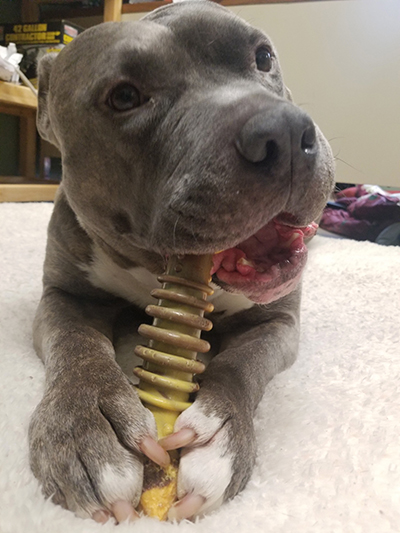
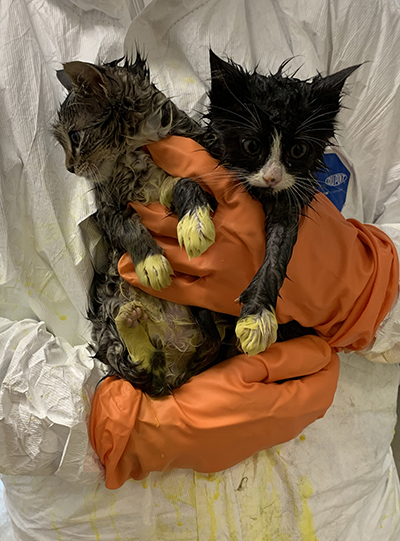
The Bedford-based nonprofit has been serving the residents — and animals — of New Hampshire for 117 years. The organization’s goal is to protect homeless, neglected or abused animals; decrease the number of unwanted animals; and keep pets and owners together,” said Charlotte Williams, president and CEO of the Animal Rescue League of New Hampshire.
“The services Carrie received are part of our community impact and outreach program. We also do adoption services, animal intake services, humane education, and investigations,” Williams said.
“If an animal is very, very sick and needs to be euthanized, we can in some cases help out with that as well. We always make the decision that is in the best interest of the animal.”
The Animal Rescue League is behind in its annual donations by about 20% and hoping the giving season will help bring much-needed revenue to the organization’s operating fund. The majority of the organization’s funding comes from individual donations, with only about 5% coming from grants or foundations. The organization was fortunate to also receive federal CARES Act money to help fulfill its mission.
“General operating funds will help us facilitate food, shelter, and medical needs of all animals at shelter getting ready for adoption,” she said. “They will assist with keeping our van on the road for pet food pantry.”
At any time, the shelter at the Animal Rescue League houses up to 130 animals. The summer brought in an influx of animals. Once the shelter-in-place was lifted, many residents had to move or found themselves in poor financial situations, ultimately choosing to surrender their animals.
“That’s why we push our community impact programs — to prevent animals from being surrendered. We want to preserve the human-animal bond,” Williams said.
The organization also employs one of three animal cruelty investigators in the state. It has contracts with eight police departments to bring in stray or abused animals.
Krysten Godfrey Maddocks is a former journalist and marketing director who writes for higher education and technology organizations in New Hampshire and Massachusetts.
Krysten won three awards — gold, silver and bronze — for writing from the Parenting Media Association in 2020.
HOW YOU CAN HELP ARL OF NH
To learn more about the Animal Rescue League of NH and its programs, go to www.rescueleague.org. Donors can reach Charlotte Williams at cwilliams@rescueleague.org or call 472-5788.
Monetary donations can be made to the ARLNH holiday campaign at www.rescueleague.org/donate-now or by mailing a donation to Animal Rescue League of NH, 545 Route 101, Bedford, NH 03110
Volunteers can help the Animal Rescue League serve its human and furry clients this winter by holding their own fundraisers or donation drives through social media or Amazon Smiles. To donate goods the animals and staff can use, there are up-todate wish lists at www.rescueleague.org/wish-lists.